

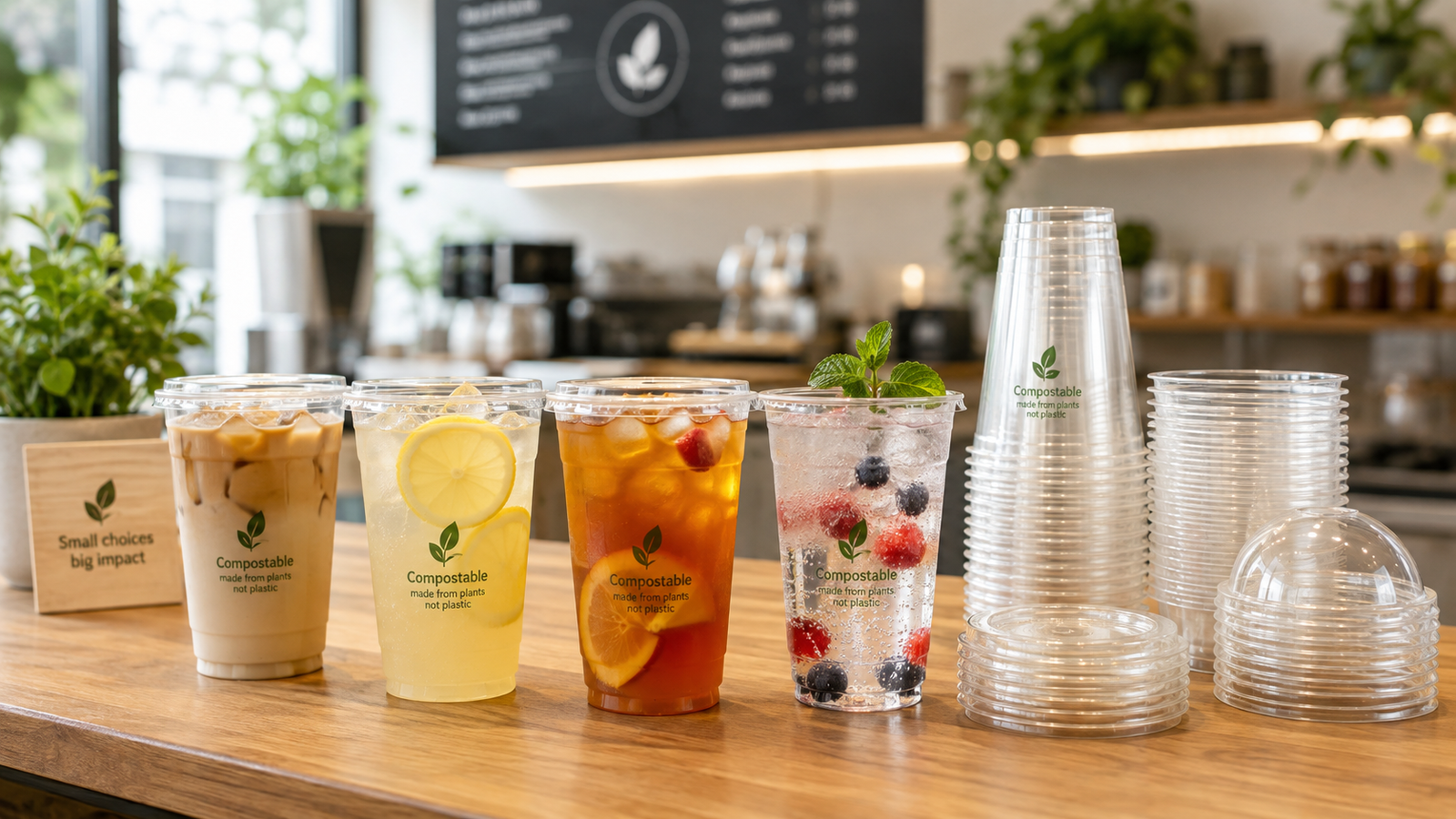
Disposable drinkware rarely attracts much attention until a business decides to change it.
For cafés, juice bars, restaurants, hotels, event companies, and takeaway brands, a clear cup has traditionally been a straightforward purchasing decision. It needs to hold the drink, fit the lid, stack efficiently, look presentable, and arrive at an acceptable cost.
That decision is becoming more complicated.
Customers are paying closer attention to packaging waste. Businesses are setting sustainability targets. Governments are changing rules for single-use products, while foodservice brands are trying to reduce conventional plastic without sacrificing the transparency and convenience customers expect from cold-drink cups.
This has created growing interest in compostable alternatives.
They are not suitable for every business or every waste system, but they are becoming an increasingly serious option for operators that want to rethink how disposable beverage packaging fits into their broader commercial and environmental strategy.
Why Clear Cups Remain Important
Before looking at alternative materials, it helps to understand why transparent cups remain so popular.
Modern cold drinks are highly visual products.
An iced latte shows layers of espresso and milk. Fruit teas contain colorful berries, citrus slices, herbs, and ice. Bubble tea depends on visible tapioca pearls and toppings. Smoothies, juices, and specialty drinks often use color as part of their appeal.
An opaque container hides much of that presentation.
Clear cups allow the drink to become part of the packaging design.
That matters even more in an age when customers routinely photograph drinks for Instagram, TikTok, restaurant reviews, and private social groups.
For beverage businesses, transparency is therefore more than a functional characteristic. It can influence perceived freshness, presentation, and even social-media visibility.
The challenge is finding materials that provide this appearance while supporting changing packaging priorities.
What Are Compostable Plastic Cups?
The term can initially sound contradictory.
How can something be both plastic and compostable?
The answer lies in the material.
Certain clear cold-drink cups are manufactured from PLA, or polylactic acid, a bio-based polymer commonly produced using renewable plant-derived feedstocks.
PLA is still a type of plastic, but its raw-material origin and potential end-of-life pathway differ from conventional petroleum-based plastics such as PET.
For foodservice operators researching alternatives, compostable plastic cups can provide the transparent appearance associated with traditional cold-drink packaging while fitting into certain certified compostable packaging programmes.
That distinction is important.
“Compostable” does not mean a cup will disappear immediately after being thrown away, nor does it mean every community can process the material effectively. The environmental outcome depends heavily on certification, collection systems, local composting infrastructure, and correct disposal.
For businesses, the material should therefore be viewed as one part of a larger packaging system rather than as a simple environmental replacement.
Why Foodservice Businesses Are Paying Attention
Several trends are pushing compostable packaging further into mainstream procurement discussions.
Customers Expect More Transparency
Consumers increasingly want to understand what products are made from and what happens after disposal.
That does not mean every customer studies packaging specifications, but environmental messaging has become more visible across cafés, supermarkets, restaurants, and delivery brands.
Businesses that make sustainability part of their identity are particularly likely to face questions about single-use packaging.
Corporate Sustainability Targets Are Expanding
Large restaurant groups, hotel companies, universities, catering businesses, and event operators increasingly have formal environmental procurement policies.
Packaging is one area where these policies become highly visible.
Switching thousands or millions of pieces of disposable packaging can have a measurable impact on a company’s material purchasing profile.
Packaging Regulations Are Changing
Governments around the world continue to introduce restrictions, taxes, labeling rules, extended producer responsibility programmes, and material requirements for disposable packaging.
The details vary substantially between markets.
Businesses operating internationally cannot assume that a packaging solution suitable for one country will automatically meet requirements in another.
Brand Positioning Matters
Packaging communicates values.
A health-focused juice bar, organic café, plant-based restaurant, or sustainability-driven event may find that conventional-looking disposable plastic packaging feels inconsistent with its wider brand identity.
Alternative materials can help create a more coherent customer experience when chosen carefully.
PLA Is Mainly Designed for Cold Drinks
One of the most important limitations of standard transparent PLA cups is heat resistance.
They are generally designed for cold beverage applications.
Typical uses include:
- iced coffee;
- cold brew;
- fruit tea;
- smoothies;
- bubble tea;
- lemonade;
- fresh juice;
- iced matcha;
- cold milk drinks;
- sparkling beverages; and
- chilled desserts.
They should not automatically be substituted for paper hot cups or high-temperature food containers.
This is an important procurement lesson.
Two clear cups can look almost identical on a shelf while behaving very differently when exposed to heat.
Businesses should choose packaging according to actual service conditions rather than appearance alone.
PLA and PET Should Not Be Confused
PET remains one of the most familiar materials used for clear disposable cold cups.
It is popular because it provides excellent transparency, good rigidity, and reliable performance across many foodservice applications.
PLA can look very similar.
But the two materials serve different priorities.
PET May Appeal to Businesses That Prioritize:
- established cold-drink performance;
- high clarity;
- conventional recycling pathways where available;
- broad availability;
- durability; and
- familiar handling characteristics.
PLA May Appeal to Businesses That Prioritize:
- bio-based materials;
- certified compostable packaging strategies;
- cold-drink applications;
- sustainability-led procurement; and
- alternative material sourcing.
Neither is automatically superior.
The right choice depends on the business, destination market, local waste infrastructure, product application, and environmental strategy.
Compostable Does Not Mean “Composts Anywhere”
This is where businesses need to be particularly careful.
Consumers often interpret the word compostable very broadly.
Certified compostable packaging is normally designed to break down under defined conditions. For many PLA products, those conditions involve industrial composting systems with controlled temperatures, moisture, oxygen, and processing times.
A cup placed in general waste may not reach that environment.
A cup discarded into nature certainly should not be expected to function as a solution to litter.
This means that before adopting compostable beverage packaging, operators should ask:
- Is suitable commercial composting available locally?
- Does the facility accept PLA?
- Is separate collection available?
- How should customers identify the correct waste stream?
- Which certification applies?
- What disposal instructions should appear on the packaging?
The answers may differ dramatically from one city to another.
The Rise of Iced Beverage Culture
Another reason clear cup demand continues to grow is the popularity of cold drinks.
Coffee culture once revolved heavily around hot beverages.
Today, cold drinks occupy a major share of many café menus.
Customers regularly order:
- iced americanos;
- iced lattes;
- cold brew;
- iced matcha;
- flavored cold coffees;
- cold foam drinks; and
- seasonal iced beverages.
In warmer regions, cold drinks may dominate the menu throughout the year.
This creates strong demand for clear cups that combine attractive presentation with efficient takeaway service.
At the same time, cafés serving younger and sustainability-conscious audiences may be among the businesses most interested in alternative packaging materials.
The result is a natural overlap between cold beverage growth and interest in PLA.
Bubble Tea Has Changed Cup Expectations
Few beverage categories demonstrate the importance of transparent packaging as clearly as bubble tea.
The product is designed to be seen.
Customers expect to see tapioca pearls, jelly, fruit pieces, milk layers, foam, colorful tea, and other ingredients through the cup wall.
Packaging becomes part of the visual identity of the drink.
Bubble tea has also encouraged businesses to think more carefully about:
- larger cup capacities;
- different lid styles;
- sealing systems;
- wide straws;
- customized branding;
- transparency; and
- cup shape.
These requirements make material selection a more technical purchasing decision than it may initially appear.
Cup Size Has a Bigger Impact Than Many Businesses Expect
Choosing the correct capacity affects both presentation and cost.
A cup that is too large can make the drink appear underfilled.
A cup that is too small may leave insufficient room for ice, toppings, foam, or fruit.
Common clear cold-cup capacities include approximately:
- 8 oz;
- 9 oz;
- 10 oz;
- 12 oz;
- 14 oz;
- 16 oz;
- 20 oz; and
- 24 oz.
A specialty coffee business may need only two or three sizes.
A juice or bubble-tea chain may require larger capacities.
The most efficient approach is usually to analyze actual beverage recipes rather than automatically stocking every available size.
The Lid Can Be Just as Important as the Cup
Cup buyers often focus on material and capacity.
Experienced operators also ask about rim diameter.
This determines which lids are compatible.
If several cup sizes share one common rim diameter, businesses may be able to use the same lid across multiple capacities.
That can simplify inventory considerably.
Imagine a café using 12 oz, 16 oz, and 20 oz cups.
If each size requires a different lid, the business has six primary packaging SKUs.
If all three use one compatible lid system, management becomes easier.
Benefits can include:
- reduced storage requirements;
- fewer staff mistakes;
- simpler purchasing;
- fewer mismatched lids;
- faster inventory counts; and
- easier multi-location standardization.
For high-volume foodservice companies, these small operational improvements can become significant.
Different Drinks Need Different Lids
The choice does not end with diameter.
Businesses may also require several lid designs.
Flat Lids
These work well for many standard iced beverages, juices, teas, and cold drinks.
Dome Lids
Dome lids provide extra space for whipped cream, fruit, smoothies, desserts, or other toppings extending above the cup rim.
Sip Lids
Some beverage concepts prefer direct-drinking lids for iced coffee and cold brew, reducing the need for a separate straw.
Straw-Slot Lids
These remain common for fruit tea, bubble tea, smoothies, and many standard cold beverages.
The ideal cup programme considers the cup and lid together rather than purchasing each separately.
Packaging Is Now Part of Brand Design
A takeaway cup does something restaurant tableware cannot do:
It leaves the building.
Customers carry drinks through shopping centres, offices, universities, airports, parks, public transportation, and city streets.
That means branded drinkware becomes mobile advertising.
Custom printing can include:
- logos;
- brand colors;
- QR codes;
- simple graphics;
- campaign messages;
- social-media accounts;
- limited-edition artwork; and
- disposal instructions.
Businesses do not necessarily need complicated designs.
In fact, transparent cups often work best with restrained graphics because the drink itself provides much of the visual interest.
A simple logo and strong color identity may create better recognition than covering the entire cup in print.
Social Media Has Increased the Value of Packaging
Food and beverage businesses once controlled most of their marketing photography.
Today, customers create enormous amounts of brand content themselves.
A visually attractive iced drink may be photographed and shared without any encouragement from the business.
If the cup carries recognizable branding, every image potentially increases exposure.
This is particularly relevant for cafés, bubble-tea shops, smoothie brands, and dessert businesses where presentation already influences purchasing.
The cup therefore sits at the intersection of packaging and marketing.
It must work operationally while still looking good in the customer’s hand.
Wholesale Purchasing Changes the Equation
Small businesses sometimes buy disposable cups by the sleeve or carton from local wholesalers.
Larger operators, distributors, importers, and restaurant groups may buy tens of thousands or hundreds of thousands at a time.
At that scale, additional factors become important.
Minimum Order Quantity
Custom manufacturing and printing typically require production minimums.
Printing Requirements
Artwork, colors, printing plates, and setup may influence both cost and minimum quantity.
Carton Packing
Buyers need to know how many cups are packed per carton.
Freight Volume
Disposable cups are lightweight but bulky.
For international shipments, cubic volume can have a major effect on landed cost.
Lead Time
Customized products require manufacturing and printing time before shipping.
Mixed Sizes
Importers may want to combine several capacities within a container.
The manufacturer should confirm minimum quantities for each individual model.
Wholesale purchasing therefore involves logistics and inventory planning, not simply comparing unit prices.
Storage Conditions Matter
PLA requires more attention to heat exposure than some conventional plastics.
This becomes particularly relevant in global supply chains.
Businesses need to think about:
- warehouse temperature;
- summer heat;
- shipping containers;
- direct sunlight;
- storage duration; and
- local climate.
A purchasing team should understand recommended storage conditions before importing large quantities.
This is another example of why sustainable packaging decisions require technical evaluation rather than relying on appearance or environmental claims alone.
Certification Matters for Business Buyers
Businesses using environmental claims need evidence to support them.
Depending on the destination market, buyers may request documentation related to:
- compostability;
- food-contact compliance;
- material composition;
- product testing; and
- manufacturing standards.
Certification requirements vary by country and customer.
A small independent café may have relatively simple purchasing requirements.
A distributor, supermarket group, multinational restaurant chain, or corporate catering business may require a much more detailed documentation package.
These requirements should be clarified before a large order is placed.
Environmental Claims Should Be Precise
Terms such as:
eco-friendly
green
biodegradable
compostable
plant-based
and
plastic-free
are often used as though they mean the same thing.
They do not.
PLA, for example, is generally described as a bio-based plastic.
Calling a PLA cup “plastic-free” would therefore be misleading.
Businesses should use accurate terminology and avoid claims that imply the packaging disappears under all environmental conditions.
Clear language protects both the business and the customer.
Samples Matter More Than Specifications Alone
Before moving to large-scale purchasing, businesses should test physical samples.
A practical test should include:
- Fill the cup with the intended drink.
- Add the normal quantity of ice.
- Fit the correct lid.
- Insert the usual straw if required.
- Test the cup during a normal takeaway period.
- Evaluate rigidity.
- Check cup clarity.
- Test stacking.
- Review customer handling.
- Examine storage behaviour.
If custom printing is required, businesses should also review how the design looks on the actual curved surface.
A digital artwork file does not always predict the final appearance perfectly.
Avoid Creating Too Many Packaging SKUs
More choice is not always better.
A café may gradually accumulate different cups for:
iced coffee, fruit tea, smoothies, specials, events, desserts, and seasonal drinks.
If each cup uses a separate lid, inventory complexity grows quickly.
A better approach is to build a coordinated cup family.
For example:
- one small capacity;
- one standard capacity;
- one large capacity;
- a shared lid diameter where possible;
- one or two lid formats;
- consistent branding.
This reduces complexity while still supporting a varied menu.
Compostable Packaging Works Best as Part of a System
Simply changing the cup does not create a complete sustainability strategy.
Businesses also need to think about:
- lids;
- straws;
- takeaway bags;
- food containers;
- cutlery;
- waste bins;
- labeling;
- collection; and
- staff training.
If a compostable cup is thrown into general waste because customers cannot identify the correct bin, the intended end-of-life strategy may fail.
Successful programmes therefore connect packaging procurement with waste-management planning.
What Businesses Should Ask Before Switching
Before purchasing compostable cold cups at scale, operators should ask suppliers several practical questions:
- What material is used?
- Which capacities are available?
- What are the cup diameters?
- Which lids are compatible?
- What temperature range is recommended?
- What certifications are available?
- What is the minimum order quantity?
- Can the cups be custom printed?
- What are the storage requirements?
- How many cups are packed per carton?
- What is the production lead time?
- Can different sizes be combined in one shipment?
These questions make it easier to distinguish a practical packaging solution from one that only sounds attractive in marketing material.
Are Compostable Cups the Future?
The future of disposable foodservice packaging is unlikely to depend on one material.
Different applications require different solutions.
PET may continue to be widely used for conventional clear cold cups.
Paper remains important for hot beverages.
Molded fiber is expanding across takeaway food applications.
PLA can play a role in cold-drink packaging where its performance characteristics and end-of-life pathway fit local conditions.
The industry is therefore moving toward more specialized material choices rather than one universal replacement.
For business owners, that means understanding materials is becoming an increasingly important part of procurement.
Final Thoughts
Compostable clear cups are moving from a niche sustainability product toward a more familiar foodservice option.
Their growth reflects several broader changes: the popularity of iced beverages, consumer concern about packaging waste, corporate sustainability programmes, new packaging regulations, and the increasing importance of takeaway branding.
But switching materials successfully requires more than selecting a cup labeled compostable.
Businesses need to evaluate temperature, size, lid compatibility, storage, certifications, waste infrastructure, branding, order quantities, and logistics.
When those elements work together, compostable cups can become a practical part of a modern beverage packaging programme rather than simply an environmental marketing statement.
The most effective packaging decisions begin with the actual needs of the business—and then select the material that fits them.

