

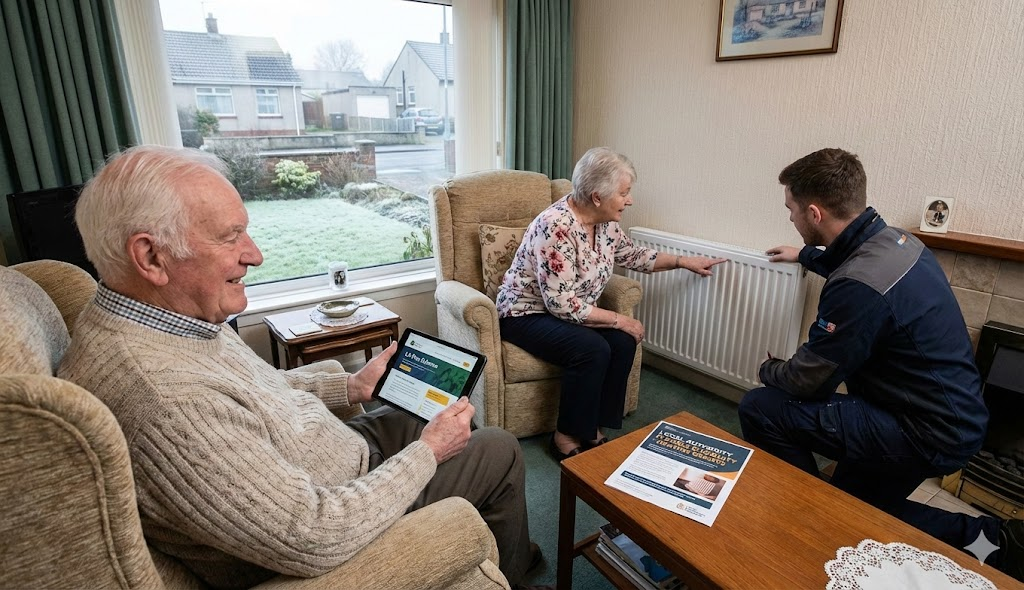
Anyone should be able to keep warm at home. It is particularly true for the elderly. Heat is good for us. Heat keeps us safe. Many pensioners are struggling with rising energy bills and old heating systems. Some schemes can help. Local Authority Flexible Eligibility is one of them.
This article will explain, in plain English, whether older homeowners can use LA Flex to heat their homes. This article explains who is eligible, what assistance is available, how to apply and where to find trusted support. You can trust my facts because I use official sources and industry information when it is helpful.
What is the LA Flex Scheme?
The LA Flex Scheme allows local councils to choose who receives help within the UK’s energy improvement programs. The LA Flex Scheme is part of the ECO (Energy Company Obligation).
The aim is to assist homes that are either cold, expensive to heat or in danger due to poor heating. The scheme gives councils the power to establish local rules. These rules may help those who are not eligible for grants at the national level.
LA Flex can finance measures such as boiler replacements, central heating systems with heat pumps and full central heating, insulation, and more.
This flexibility is designed to reach households who are vulnerable, have a low income and are not receiving certain benefits.
Can elderly homeowners use LA Flex?
Yes. Elderly homeowners can often use LA Flex for heating upgrades. Councils may prioritise older people when they design local eligibility. Age alone is not always the only qualifier. Many councils treat pensioners as a vulnerable group.
That means a person over a certain age who is struggling to heat their home, or who has a low income, may be eligible. Eligibility depends on a mix of local rules, the home’s energy efficiency rating, and proof of low income or vulnerability.
It is common for LA Flex to be used to help pensioners who do not receive means-tested benefits but still live in fuel poverty or have health issues made worse by cold homes.
Which elderly homeowners are most likely to qualify?
Local councils can set their own LA Flex criteria. Nevertheless, some themes appear to be common. Many councils are looking for indicators of vulnerability, such as low income and poor energy efficiency (an EPC of D, E or F).
Vulnerability is a combination of age, chronic illnesses, mobility problems, and being advised by a doctor to keep your home warm. Some councils guide their decisions by using income thresholds.
In practice, it is often pensioners who have a modest retirement income and poor heating or health issues that receive help.
LA Flex was designed to be flexible, so councils are able to combine different types of proof of need in order for LA Flex to expand eligibility beyond the national benefit test. This helps older homeowners who are not eligible for standard benefits.
Typical heating measures available under LA Flex
Local schemes, such as LA Flex, can help fund heating improvements. It includes installing brand-new high-efficiency boilers and replacing broken systems. Heating upgrades are often accompanied by insulation and draught proofing to ensure that the new system will be effective and efficient.
If the home is not connected to the gas grid, heat pumps or electric heating upgrades may be recommended.
The specific measures that are offered will be determined by the local council’s priorities and housing stock. These options are designed to reduce energy bills, improve health and warmth outcomes and lower energy costs.
How common is fuel poverty among older people?
Fuel poverty continues to be a major problem in the UK and affects many older homes. About 11.0% of English households were estimated to have fuel poverty in 2024. This equates roughly to 2.7 million homes using the Low Income Low Efficiency measure of the government.
This group includes many older people who live in houses with low energy efficiency, and have a fixed income or a fixed income. In some areas and in homes off of the gas grid, this problem is more severe. This shows why LA Flex remains important for older homeowners.
Income and document evidence: what councils ask for
When a homeowner submits an LA Flex application, the local authorities usually request proof. This includes bank statements or pension statements. Payslips and other proof of household income are also acceptable.
As evidence of vulnerability, councils may accept medical letters or housing records. Local schemes may use proxy indicators, such as having a low income but not receiving benefits, being on the waiting list for social accommodation, or meeting certain criteria.
These proofs allow councils to apply LA Flex for people who otherwise would not be eligible due to national benefit tests. Local partners and trusted installers can assist in gathering the necessary documents.
Are there age cut-offs or special rules for pensioners?
LA Flex does not have a national cut-off age. Some local schemes have specific priorities for pensioners based on their age, while others use age as a vulnerability indicator.
In its eligibility guidelines, a council might list “over 60” and “over 65” among other factors. In some areas, medical conditions and income will be taken into consideration along with age.
The rules differ by council, so it is best to contact the local authority or an approved installer who knows the LA Flex criteria in your area.
The local opinion will let you know if age is enough to support an application, or if other supporting evidence will be needed.
Practical steps for elderly homeowners
Start with a local check if you’re an older homeowner who is interested in LA Flex. Contact the housing or energy department of your local council. Ask if they have an LA Flex route and what local proxy they accept for eligibility.
Prepare any recent medical letters and income proof that shows a need for warmth. Contact a TrustMark-approved installer or an experienced company with LA Flex if you prefer. These companies can help you with the paperwork and survey your home.
These organisations can explain to you which heating measures will work for your home, and how long it might take. Before any survey, many installers offer a free eligibility assessment.
Berks Insulation: a trusted partner for older homeowners
Berks Insulation, one of the installers that advertises as a trusted provider that helps homeowners to access LA Flex financing, is one such company.
The company claims that they support low-income households and vulnerable families through this route, offering help with applications and surveys, installation and aftercare.
Working with a partner who understands local council processes, LA Flex paperwork, and the LA Flex application can be a great help for older homeowners.
This reduces stress and ensures that the correct evidence is provided. Check their accreditation and ask for reviews from customers before you begin any work.
Final thoughts and practical advice
LA Flex can be a good option for older homeowners. This is not an all-encompassing scheme because local councils may have different rules. Its strength is the local flexibility. This can be a great option for people who do not receive benefits but are still unable to heat their home properly.
Contact your local council or reputable installers if you are an older homeowner with a house that is difficult to heat or whose bills are high. Check your eligibility and gather the required documents. Ask a trusted friend to assist you in the application if you want support.
Even small steps can make a real difference in terms of health, warmth and cost. Combining council support via LA Flex with trusted installers will make a difference for older people who live in cold homes.

